2.2 Types of Variables and Levels of Measurement
Once we know what our variables are, we need to understand how they were measured. This matters because the type of variable affects which descriptive statistics, graphs, and statistical tests make sense.
This may or may not be refresher material for you, but it is extremely important. A lot of statistics comes back to one basic question: What kind of variable am I working with?
By the end of this section, you should be able to:
- distinguish between categorical and continuous variables
- identify nominal, ordinal, interval, and ratio levels of measurement
- explain why variable type depends on how something is measured
- recognize why numbers do not automatically make a variable continuous
- explain why researchers should be cautious about collapsing variables into fewer categories
Categorical and Continuous Variables
A useful first distinction is between categorical and continuous variables.
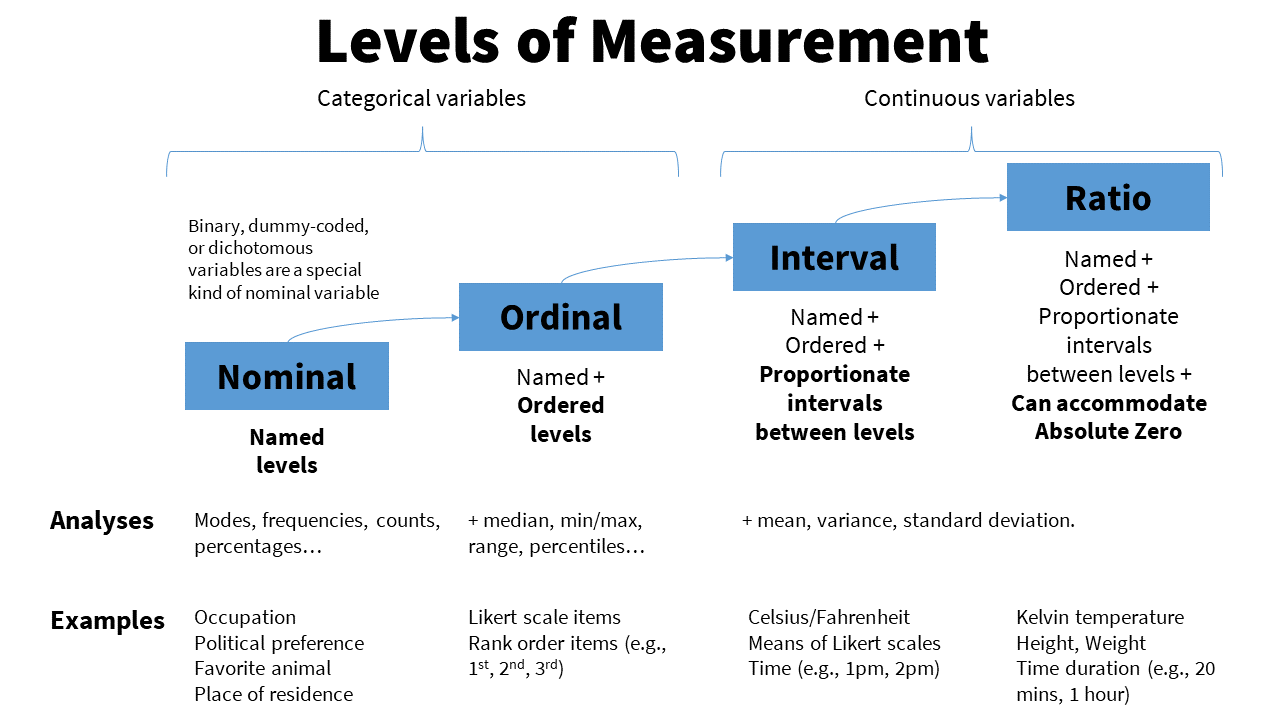
describe groups or categories. Examples include major, condition, political affiliation, or whether someone completed a task.
represent quantities or amounts. Examples include age, height, reaction time, test score, or number of correct responses.
This distinction will show up constantly in jamovi. Later, jamovi will ask you to identify variables as nominal, ordinal, continuous, or ID. That choice affects which analyses jamovi will allow you to run.
Nominal Variables
A is a categorical variable with categories that do not have a meaningful order.
Examples include:
- major
- treatment group
- eye color
- state of residence
- type of pet
For nominal variables, we can count how many observations fall into each category and calculate percentages. We can also identify the mode, or most frequent category.
What we cannot do is calculate a meaningful mean. If we code cat = 1, dog = 2, and frog = 3, the mean of those numbers does not tell us anything meaningful about the animals. The numbers are just labels.
A special type of nominal variable has only two categories, such as yes/no, present/absent, or control/treatment. These are often called , , or dummy-coded variables.
Ordinal Variables
An is a categorical variable with categories that have a meaningful order.
Examples include:
- class rank
- education level
- Likert-type responses from strongly disagree to strongly agree
- satisfaction ratings from very dissatisfied to very satisfied
Ordinal variables give us more information than nominal variables because the categories can be ordered. However, the spacing between categories is not necessarily equal.
For example, on a five-point satisfaction scale, the difference between “strongly disagree” and “disagree” may not be exactly the same as the difference between “agree” and “strongly agree.” The values are ordered, but the distance between values is not guaranteed to be equal.
With ordinal variables, we often use frequencies, percentages, medians, ranges, or percentiles. Researchers sometimes treat ordinal scales as continuous, especially when multiple items are combined into a scale score, but we should always think carefully about whether that choice makes sense.
Interval and Ratio Variables
and are both types of continuous variables.
An interval variable has equal spacing between values, but no true zero point. Temperature in Celsius or Fahrenheit is a common example. The difference between 20 and 30 degrees is the same size as the difference between 30 and 40 degrees, but 0 degrees does not mean there is no temperature.
A ratio variable has equal spacing between values and a true zero point. Examples include reaction time, number of correct answers, height, weight, and hours studied. For ratio variables, zero means none of the thing being measured.
For most of this book, you do not need to spend much energy distinguishing between interval and ratio variables. jamovi does not separate them either. Instead, jamovi treats them as continuous variables. The more important distinction for our purposes is whether a variable is nominal, ordinal, or continuous.
The Same Construct Can Be Measured in Different Ways
Here is one of the most important things to remember:
A variable’s level of measurement depends on how it is measured, not just what it is called.
One semester, a student asked me, “Isn’t time a continuous variable?” My answer was: it depends on how time is measured.
- If time is measured as pre vs. post, it is a nominal variable with two categories.
- If time is measured as month of the year, it is ordinal because the months have a meaningful order.
- If time is measured as response time, exact date, or time remaining, it is typically continuous.
So “time” is not automatically one type of variable. The researcher’s measurement choices determine the level of measurement.
Here is another example. The construct of studying could be measured in several ways.
| Name | Study_Continuous | Study_Ordinal | Study_Nominal |
|---|---|---|---|
| Name | Hours studied per day | Amount of studying | Studies every day? |
| Jesus | 5.0 | A great deal | Yes |
| Nicky | 4.5 | A great deal | Yes |
| Bradford | 3.2 | A moderate amount | Yes |
| Sylvia | 1.7 | A small amount | Yes |
| Martha | 0.2 | Rarely | Yes |
| Lillian | 0.0 | Never | No |
| Trayvon | 0.0 | Never | No |
Notice that the same general idea, studying, can be measured as:
- continuous: hours studied per day
- ordinal: amount of studying on an ordered scale
- nominal: whether the person studies every day
This is why variable type is not just a vocabulary issue. It affects the information we have available and what analyses we can reasonably perform.
Be Careful About Losing Information
Continuous variables usually contain more information than ordinal variables, and ordinal variables usually contain more information than nominal variables.
We can often move from continuous to ordinal or nominal. For example, we could turn hours studied into low, moderate, and high studying. We could also turn it into yes/no by asking whether someone studied at least one hour.
But once we do that, we lose information. Someone who studied 1.1 hours and someone who studied 5.0 hours might end up in the same category. That may be useful for some research questions, but it can also make the analysis less precise.
Because of this, researchers should be cautious about , , and collapsing categories. Sometimes there is a good reason to do it. But “this makes the analysis easier” is usually not a strong enough reason on its own.
A Quick Decision Guide
When you encounter a variable, ask yourself:
- Does this variable describe categories or quantities?
- If it describes categories, is there a meaningful order?
- If it describes quantities, should jamovi treat it as continuous?
- Are the numbers meaningful quantities, or are they just labels?
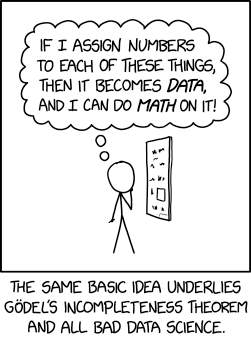
That last question is especially important. Assigning numbers to categories does not magically make something continuous.
- Is favorite color nominal, ordinal, or continuous?
- Is class rank nominal, ordinal, or continuous?
- Why is time not automatically a continuous variable?
- Why might a researcher avoid turning a continuous variable into “high” and “low” groups?
Answers
- Favorite color is nominal because the categories do not have a meaningful order.
- Class rank is ordinal because the categories or ranks have a meaningful order.
- Time depends on how it is measured. Pre/post time is categorical, month can be ordinal, and reaction time is continuous.
- Turning a continuous variable into categories removes information and can make analyses less precise.